Greehouse effect
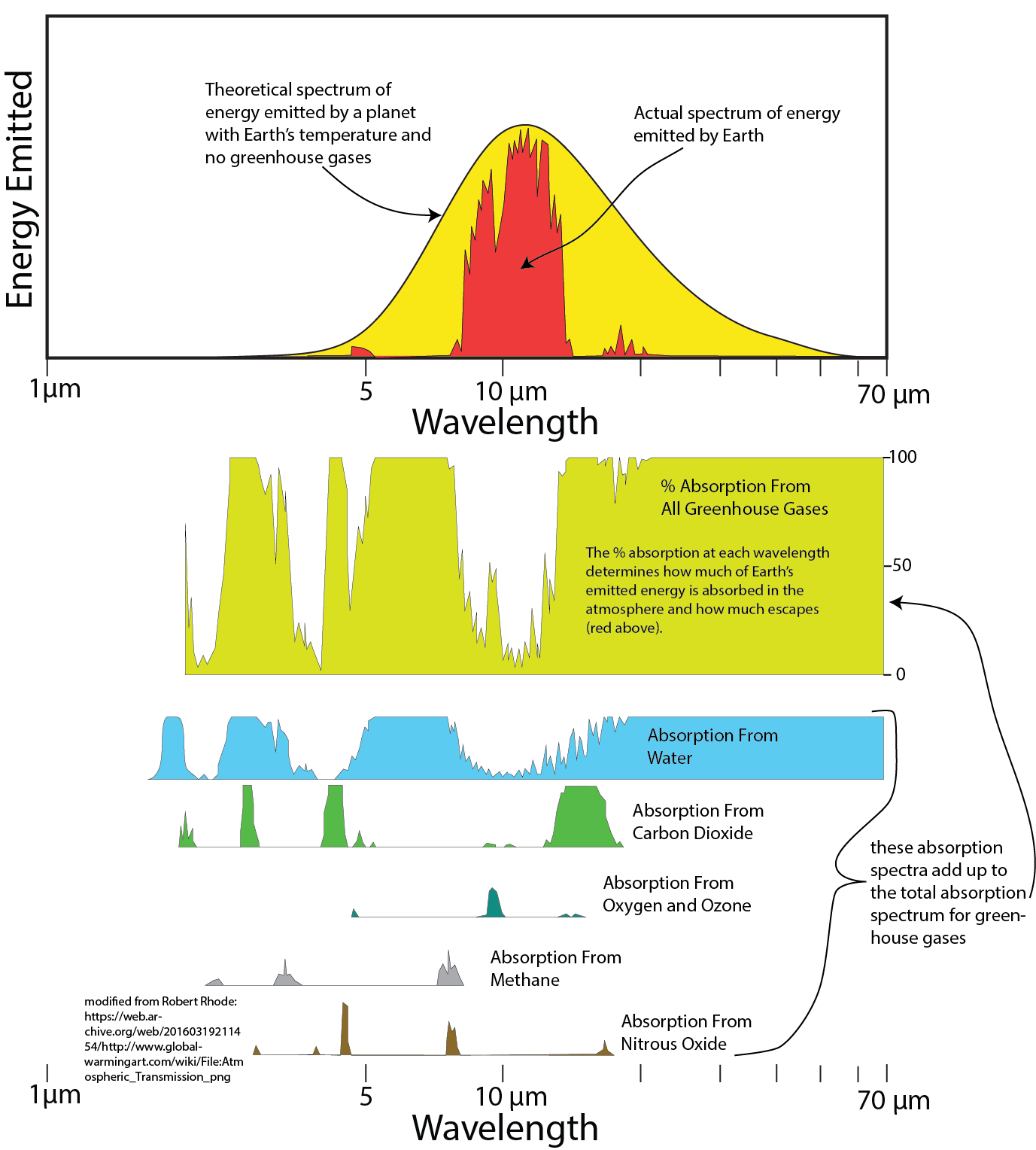
The most relevant greenhouse gases are : C02, CH4, H2O, Fgase N20
See Climate Watch, WRI : Ge, M., Friedrich, J., Vigna, L., 2026. Where Do Emissions Come From? These Charts Explain Greenhouse Gas Emissions by Sector. and slides at https://www.slideshare.net/slideshow/the-latest-trends-in-global-emissions-april-2026/287288564 Look for data sources there
Global Warming Potential
https://www.epa.gov/ghgemissions/understanding-global-warming-potentials
Starting in 1990, the Intergovernmental Panel on Climate Change (IPCC) used the Global Warming Potential (GWP) to allow comparisons of the global warming impacts of different gases. Specifically, it is a measure of how much energy the emission of 1 ton of a gas will absorb over a given period of time, relative to the emission of 1 ton of carbon dioxide (CO2).
Methane (CH4) is estimated to have a GWP of 27-30 over 100 years
Nitrous Oxide (N2O) has a GWP 273 times that of CO2 for a 100-year timescale
Chlorofluorocarbons (CFCs), hydrofluorocarbons (HFCs), hydrochlorofluorocarbons (HCFCs), perfluorocarbons (PFCs), and sulfur hexafluoride (SF6) are sometimes called high-GWP gases because, for a given amount of mass, they trap substantially more heat than CO2. (The GWPs for these gases can be in the thousands or tens of thousands.)
REad Wijngarden and Happer, Dependence of Earth's Thermal Radiatin n Five most abundant Greenhouse Gases arXiv:2006.03098 https://www.youtube.com/watch?v=chDl-u4va_A 6:16